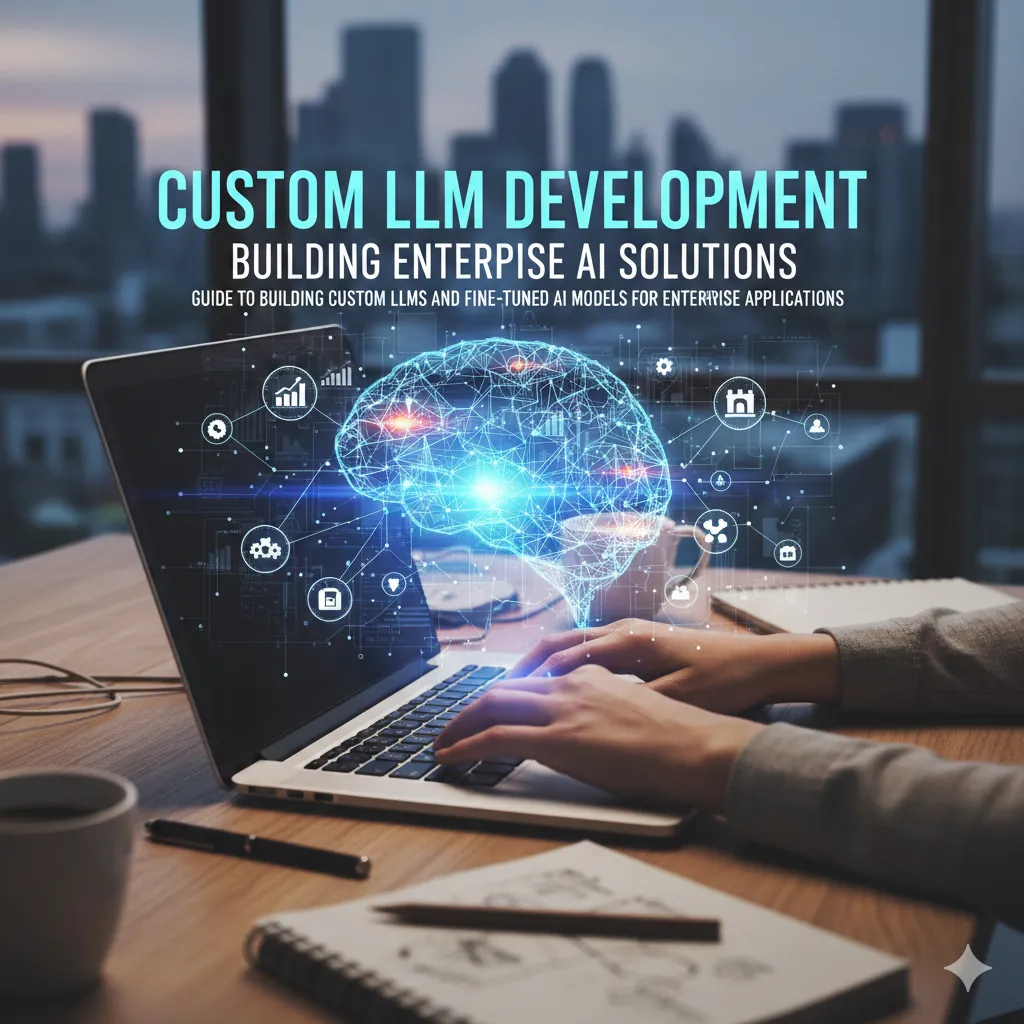
Custom LLM development lets enterprises build domain-specific AI with better accuracy, lower costs, and full data privacy - via three main approaches: fine-tuning existing models ($20K - $100K), retrieval-augmented generation ($30K - $150K), or custom training from scratch ($500K+).
While general-purpose LLMs like GPT-4 and Claude are powerful, custom LLM development enables enterprises to build AI that truly understands their domain, data, and requirements - with better accuracy, lower costs, and complete data privacy.
When Do You Need a Custom LLM?
- Domain expertise - Legal, medical, financial terminology
- Proprietary data - Internal documents, processes, history
- Cost optimization - High-volume use cases
- Data privacy - Sensitive data can't leave your infrastructure
- Specialized tasks - Better performance on narrow use cases
Custom LLM Development Approaches
1. Fine-Tuning Existing Models
Take a base model (Llama, Mistral) and train it on your data. Fastest and most cost-effective approach for most use cases.
- Timeline: 2-4 weeks
- Cost: $20,000 - $100,000
- Best for: Domain adaptation, style matching
2. RAG (Retrieval-Augmented Generation)
Combine LLM with your knowledge base. Model retrieves relevant context before generating responses.
- Timeline: 4-8 weeks
- Cost: $30,000 - $150,000
- Best for: Q&A systems, documentation, support
3. Custom Training from Scratch
Train a model specifically for your use case. Requires significant data and compute resources.
- Timeline: 3-12 months
- Cost: $500,000+
- Best for: Unique requirements, competitive advantage
Enterprise LLM Architecture
- Model layer - Fine-tuned or custom LLM
- Retrieval layer - Vector database (Pinecone, Weaviate)
- Orchestration - LangChain, custom agents
- Guardrails - Output validation, safety filters
- Monitoring - Quality metrics, drift detection
Data Requirements
- Fine-tuning: 1,000-100,000 examples
- RAG: Your knowledge base (any size)
- Custom training: Millions of tokens minimum
Infrastructure Options
- Cloud (AWS, GCP, Azure) - Scalable, managed
- On-premise - Full control, compliance
- Hybrid - Development in cloud, production on-prem
Why Choose Weiblocks for Custom LLM Development
At Weiblocks, we've built custom AI solutions for enterprises across industries. We handle the full stack: data preparation, model selection, fine-tuning, deployment, and ongoing optimization.
- Expertise in open-source and commercial LLMs
- Secure, compliant infrastructure options
- Production-grade deployment and monitoring
- Ongoing model maintenance and improvement
Ready to Build Your Custom LLM?
Contact Weiblocks for an AI strategy consultation. We'll assess your requirements and recommend the optimal approach for your enterprise AI needs.